Saturday, 27 November 2021

William Wordsworth


Hello, I am Himanshi Parmar, here i am going to write a blog on very well known English Romantic poet William Wordsworth, as a part of Thinking activity about Romantic poets. Here i discuss about his life, his literary career, some interesting facts about him. And some of his important poems is in brief.


    William Wordsworth was one of the most important figure of the Romantic Age. He was an English Romantic Poet, with Samuel Taylor Coleridge, he launched the Romantic age in English literature, with their combined publication of Lyrical Ballads. He was born on 7 April 1770, in cocker mouth, united Kingdom. He was the second of five children of a modestly prosperous estate manager. He lost his mother when he was 7 and his father when he was 13, upon which the orphan boys were sent off by guardian uncles to a grammar school at Hawkshead, a village in the heart of the Lake District. At Hawkshead Wordsworth received an excellent education in classics, literature, and mathematics.

Also Wordsworth attended Hawkshead Grammar School, where his love of poetry was firmly established and, it is believed, he made his first attempts at verse. While he was at Hawkshead, Wordsworth's father died leaving him and his four siblings orphans. After Hawkshead, Wordsworth studied at St. John's College in Cambridge and before his final semester, he set out on a walking tour of Europe, an experience that influenced both his poetry and his political sensibilities. While touring Europe, Wordsworth came into contact with the French Revolution. This experience as well as a subsequent period living in France, brought about Wordsworth's interest and sympathy for the life, troubles, and speech of the "common man." These issues proved to be of the utmost importance to Wordsworth's work. 

Wordsworth's marriage life and literary life :-

Now let us discuss something about Wordsworth's literary career. He was a great poet of nature. Nature and its objects get reflection in many of his works. In 1795, Wordsworth received an inheritance that allowed him to live with his sister, Dorothy. That same year, Wordsworth met Samuel Taylor Coleridge. The two became friends, and together worked on Lyrical Ballads (1798). The volume contained poems such as Coleridge's "Rime of the Ancient Mariner" and Wordsworth's "Tintern Abbey," and helped Romanticism take hold in English poetry. And his literary life starts.

The same year that Lyrical Ballads was published, Wordsworth began writing The Prelude, an epic autobiographical poem that he would revise throughout his life, it was published posthumously in 1850. While working on The Prelude, Wordsworth produced other poetry, such as "Lucy." He also wrote a preface for the second edition of Lyrical Ballads; it described his poetry as being inspired by powerful emotions and would come to be seen as a declaration of Romantic principles.

In 1802, a temporary lull in fighting between England and France meant that Wordsworth was able to see Vallon and their daughter, Caroline. After returning to England, he wed Mary Hutchinson, who gave birth to the first of their five children in 1803. Wordsworth was also still writing poetry, including the famous "I Wandered Lonely as a Cloud" and "Ode: Intimations of Immortality." These pieces were published in another Wordsworth collection, Poems, in Two Volumes (1807).

Evolving Poetry and Philosophy
As he grew older, Wordsworth began to reject radicalism. In 1813, he was named as a distributor of stamps and moved his family to a new home in the Lake District. By 1818, Wordsworth was an ardent supporter of the conservative Tories.

Though Wordsworth continued to produce poetry including moving work that mourned the deaths of two of his children in 1812 he had reached a zenith of creativity between 1798 and 1808. It was this early work that cemented his reputation as an acclaimed literary figure.

Death :- 

In 1843, Wordsworth became England's poet laureate, a position he held for the rest of his life. At the age of 80, he died on April 23, 1850, at his home in Rydal Mount, Westmorland, England.He was died from an aggravated case of pleurisy, and was buried at St Oswald's Church, Grasmere.
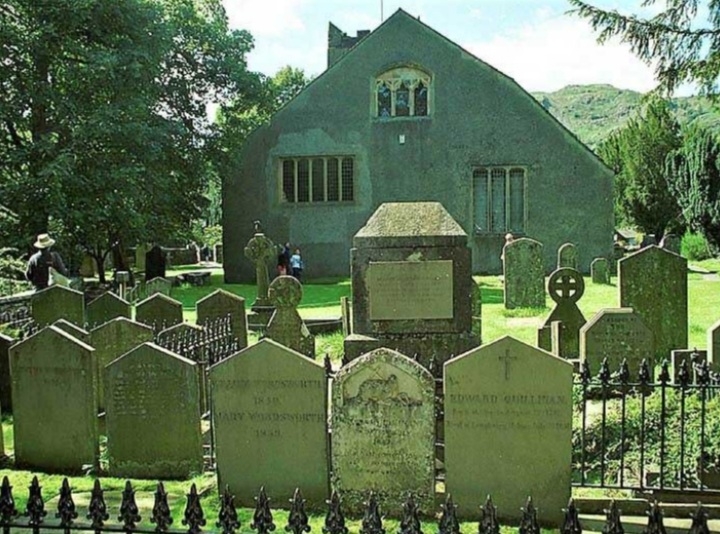
   
 This are the graves of William Wordsworth and his Family, in St Oswald's Church, Grasmere.

Interesting facts about Wordsworth :-

Here let me mentioned some interesting facts about Wordsworth's life.

1) Wordsworth was separated from his sister, Dorothy :- 

  After the death of their mother in 1778, William and Dorothy were torn apart by their father, who sent them to live with different relatives and Wordsworth ended up in Penrith. They didn’t see each other for the next nine years, despite having been so close as children.

  After being reunited, they made up for lost time by spending many of the next few decades living and travelling together, even taking trips to France and Germany.

2) ‘I wandered lonely as a cloud’ wasn’t entirely written by Wordsworth :- 

More commonly known as ‘Daffodils’, Wordsworth’s most famous poem is considered to be ‘I Wandered Lonely as a Cloud’. This lyric poem was inspired by a walk Wordsworth took with his sister Dorothy where they came across a field of yellow daffodils on the shores of Glencoyne Bay at Ullswater.

The poem itself was written two years after the fact, but what you didn’t know was two of its famous lines, often mentioned in the school curriculum, weren’t in fact written by Wordsworth.

‘They flash upon that inward eye

Which is the bliss of solitude’

The lines above were added by Wordsworth’s childhood friend and future wife, Mary Hutchinson.

3) Wordsworth was inspired by her sisters journals :-

interestingly, Wordsworth often found inspiration for his poetry by reading from Dorothy’s journal, in which she kept detailed accounts of her explorations through nature. Dorothy is now considered to be a writer herself because of this and many of her journals can be read at Dove Cottage.

4) William Wordsworth as a poet laureate for seven years :-

he maintained the title of poet laureate, until his death despite not writing a single verse during that time.

Considering himself too old for the title and responsibility, Wordsworth initially declined the offer to be Poet Laureate but was assured by the Prime Minister at the time, Robert Peel, that there would be no expectation of him to write further.

William Wordsworth’s Poet Laureate status was taken entirely on his previous merit as a writer. Wordsworth did continue to write personally, but no further work of his was ever published and he officially gave it up in 1847, after the death of his daughter.

5)Mike Myers is a descendant of William Wordsworth :- 

Mike Myers Hollywood Star, famous actor is actually related to Wordsworth. the Canadian-born actor, best known for his iconic portrayal of Austin Powers, is in fact Wordsworth’s first cousin, seven times removed.


Some of his Famous Poems :-

1] The Prelude :- 

“The Prelude” is an autobiographical poem in black verse by William Wordsworth, which he started writing at the age of 28 in 1798 and continued writing it throughout his life. Published posthumously in 1850, the poem was first intended as an introduction to his philosophical poem “The Recluse”, which Wordsworth never did finish.

2] Tintern Abbey :-


“Tintern Abbey” is William Wordsworth’s most famous poems, published in 1798. It is a conversational poem that contains elements of an Ode and dramatic monologue. The poem is based on a small place situated in the village of Tintern in Monmouthshire, on the Welsh bank of the River Wye. Wordsworth, through this poem, helps his readers understand his philosophies on nature and its beauty.

3] Ode: Intimations of Immortality :-

Referred to as Wordsworth’s greatest ode, the poem explores the narrator’s divine relationship with nature. The poem compares the deep connection between a child and the nature, which is lost when the child grows and loses his divine vision. However, the narrator’s recollections of the past allows him to relive his relationship with the nature

4] The Solitary Reaper :-


Published in 1807, “Solitary Reaper” is a beautiful ballad about a young girl, who is reaping in the fields and whose song captivates the attention of the narrator. He is so mesmerized by the song’s tone, expression and lyrical composition that he asks passers-by to wait and listen to the reaper’s song. The ballad is one of Wordsworth best known works.

5] Daffodils :-


One of the classics in English Romantic poetry, “Daffodils” tells a tale about a poet discovering a field of the beautiful flowers while wandering around a village. Published in 1807, the poem was inspired by Wordsworth’s encounter with a long belt of daffodils while taking a walk with his sister Dorothy in April 1802.

6] Ode to Duty :-

Another one of Wordsworth’s odes, “Ode to Duty” deals with the poet’s attitude and understanding towards the idea of duty. As much as he appreciates love and joy, he feels there is more grace and significance in the nature of duty. Although stern, he thinks duty is also graceful and divinely beautiful, if performed with a greater purpose.

7] London 1802 :-

Composed in 1802 itself, the poem is a medium that Wordsworth uses to reprimand his fellow English people for becoming selfish and morally stagnant. He eulogises seventeenth-century poet John Milton and explains how Milton could improve the present situation of England if he was alive. Through “London 1802”, Wordsworth shed light upon the deteriorating conditions of the English society while paying homage to Milton.

8] Composed upon Westminster Bridge :-

Written in 1802, the sonnet was composed to depict the beauty of London in the early morning light. While standing on the Westminster Bridge, the poet admires the early morning serenity of his surroundings, which will eventually be destroyed by the industrial activities during the day.

9] Strange Fits of Passion have I known :-

Written in 1798, the poem was one of the most famous amongst Wordsworth’s ‘Lucy Poems’. After the poet’s death, many critics and publisher came together and created a collection of five poems by Wordsworth written between 1798 and 1801 and named it the ‘Lucy Poems’. “Strange Fits of Passion have I known” is also a part of the collection and revolves around the fantasy of Lucy’s death.

10] Resolution and Independence :-

Composed in 1802, “Resolution and Independence” is a beautiful lyric poem by William Wordsworth published in 1807 in ‘Poems, in Two Volumes’. The poem is based on Wordsworth’s actual encounter with a leech-gatherers near his home at Dove Cottage in Grasmere.


Thus to conclude, we can able to say that William Wordsworth is one of the major romantic poet. People also concider him nature poet. He was the Father of Romantic Movement. Here we discussed about his life, some of the interesting facts about him, and some of his major works.


Words :- 1817
Paragraphs :-19
Images :- Nine
Videos :- Three
References :-

1) Brittanica.com
2) poets.org
3) biography.com
4) sykescottage.com
5) timesofindia.com


Sunday, 21 November 2021

Metaphysical Poetry


Hello, I am Himanshi Parmar. As a Part of Blog task, here i write a blog about Metaphysical poetry and some of the notable poems of that time. But before that i want to write about my own experience of learning this unit, 'metaphysical poetry' is in online mode.

   R. K. Mandaliya sir was  taught this unit to us. He start the unit with basic informations about metaphysical poetry, so that all students can easily understand the base of that poetry. And i think because of that easy starting, i got intrest in the lectures. Also Sir's teaching style is quite interesting, as he gave us so many examples from various Fields like cinema, sculpture etc. This thing kept my intrest throughout the lectures.

  Also i enjoyed all the poems. As sir sing it and explain, it is much easier to understand the concept. I never feel comfortable with online studies because it's less interactive. But this lectures of 'metaphysical poetry', i found much interesting and easy. Mandaliya sir was also dictated some questions. As he dictate the questions, repeat all the sentence twice a time, spell all hard spelling. That all thing are being very useful to us. And make the concept of 'metaphysical poetry' clear in our mind.  Now let me start my blog about characteristics and poems of 'metaphysical poetry'.

    
      Metaphysical poetry is a group of poems that share common characteristics and they all are highly intellectualized, uses strange imaginary and contain complex thoughts. The group of metaphysical poets emerged in the second half of the sixth century.  Metaphysical poems also have the elements of metaphors, metaphysical conceits, paradoxes, and analogies. Metaphors and metaphysical conceits, a type of extended metaphor, are used to show a connection between two things that are not similar and to prove the speaker's point in his poem.

   A metaphysical conceit is an extended metaphor that makes an outstretched comparison between a person's spiritual faculties and a physical object in the world. For example Metaphysical poets such as John Donne and Andrew Marvell, among others, made use of metaphysical conceits to explore the relationships between lovers by such poems like The Flea, To his coy mistress, and other.

   Literary critic and poet Samuel Johnson first coined the term 'metaphysical poetry' in his book Lives of the Most Eminent English Poets (1179-1781). In the book, Johnson wrote about a group of 17th-century British poets that included John Donne, George Herbert, Richard Crashaw, Andrew Marvell and Henry Vaughan.

  Now let me discuss about some of the important definitions and the meaning of metaphysical poetry.

1] definition and meaning of Metaphysical poetry :- 

Metaphysical is a philosophical concept used in literature to describe the things that are beyond the description of physical existence. ... '

     The meanings are clear that it deals with the things that are beyond this the existence of the physical world.Also The term metaphysics comes from Aristotle, it means a science which investigates being as being reality rather than poetic convention, exploring life through the senses. A 'metaphysical conceit' is an extended metaphor; making ingenious comparisons between two apparently incongruous things or concepts.

   If we understand the word 'metaphysical', then it is like - 'meta' means 'beyond' and 'physics' means 'physical nature'.Metaphysical poetry means poetry that goes beyond the physical world of the senses and explores the spiritual world. Metaphysical poetry began early in the Jacobean age in the last stage of the age of Shakespeare.

     Metaphysical poetry began early in the Jacobean age in the last stage of the age of Shakespeare.
John Donne was the leader and founder of the metaphysical school of poetry. Dryden used this word at first and said that Donne “affects the metaphysics”. Among other metaphysical poets are Abraham Cowley, Henry Vaughan, Richard Crashaw, Andrew Marvell, George Herbert, Robert Herrick etc.

So this how we can identify metaphysical poetry, different from other era's poetry. Now let me switched to characteristics of metaphysical poetry.

2] characteristics of the metaphysical poetry :-

(1) Dramatic manner and direct tone of speech :-

     This is one of the major characteristic of the metaphysical poetry. We found this Dramatic spice and direct tone and subject which is taken from the field which is not related anyhow with literature, Is in many poems, like in the starting of the poem, "The Canonization" - there is given dramatic starting.

For God's sake hold your,
Tongue, and let me love.

(2)  Fondness for conceits :-

   Fondness for conceits is a major character of metaphysical poetry. Donne often uses fantastic comparisons. The most striking and famous one used by Donne is the comparison of a man who travels and his beloved who stays at home to a pair of compasses in the poem “A Valediction: Forbidding Mourning”

“If they be two, they are two so
As stiff twin compasses are two,
Thy soul fixt foot makes no show
To move, but doth, if th’other do”.
We find another conceit in the very beginning couple of lines of “The Extasie”

“Where like a pillow on a bed,
A pregnant bank swel’d up.”

(3) Metaphysical Poetry is a blend of passion and thought :-

  T. S. Elliot thinks that “passionate thinking” is the chief mark of metaphysical poetry. There is an intellectual analysis of emotion in Donne’s Poetry. Though every lyric arises out of some emotional situation, the emotion is not merely expressed, rather it is analyzed. Donne’s poem “A Valediction: Forbidding Mourning” proves that lovers need not mourn at parting. For instance,

“So let us melt, and make no noise,
No tear-floods, nor sigh-tempests move,
‘Twere profanation of our joys
To tell the laity our love”.

(4) Wit :-

Perhaps the most common characteristic is that metaphysical poetry contained large doses of wit. In fact, although the poets were examining serious questions about the existence of God or whether a human could possibly perceive the world, the poets were sure to ponder those questions with humor.

(5) Unclarity :-

    Metaphysical poetry is considered highly ambiguous and obscure due to high intellect and knowledge of metaphysical poets. The poetry is greatly challenging to understand at the first reading. It needs full concentration and full attention to getting to the roots of the matter. Metaphysical poetry is considered to be brief and concise. Every line conveys a lot of meanings in a few words. Every word is adjusted in every line like a brick in a wall and conveys the message of the author. Hence there is no wastage of words.

(6) Express love and faith in Christianity :-

   metaphysical poetry express love and faith in Christianity. It talks about deep things. It is also talks about soul, love, religion, reality etc. You can never be sure about what is coming your way while reading a metaphysical poem. There can be unusual philosophies and comparisons that will make you think and ponder. Also they brought the subject of their poetry from various fields like Geography, Biology, Engineering, Architecture, Geometry, Political Science etc. This thing gave unique identity to their poetry ans make them different from Elizabethan poets.

To read more characteristics click here.

   Now let me discuss about some important poems of Metaphysical age.

(1) The Flea :-

   The Flea is one of the most popular metaphysical poem published in 1633. The poem written by a well known poet John Donne (1572-1631).Donne wrote this poem in the 1590s when he was a young law student at Lincoln's Inn, before he became a respected religious figure as Dean of St. Paul's Cathedral. The poem uses the conceit of a flea, which has sucked blood from the male speaker and his female lover, to serve as an extended metaphor for the relationship between them. The speaker tries to convince a lady to sleep with him, arguing that if their blood mingling in the flea is innocent, then sexual mingling would also be innocent.

Summary of the poem :-

   In the poem a lover tries to convince his beloved for physical interaction. And for that he told his beloved to look at the Flea. And then he explains that the flea first sucked his blood, then her blood, so that now inside the flea, they are mingled and so that, this mingling can not be called, "sin, or shame, or loss of Maidenhead". As her beloved denied and considering that thing. He tries to convince his beloved that the flea joined them together.

"Alas, is more than we would do".

  When his beloved tries to kill the flea, he stopped her and tell that she is doing sin by killing three lives. The life of him, life of herself and flea's life, also he used to give example that when the flea sucked both of them. They get married and now flea is like their marriage temple. Then the speaker calls his lover as "cruel and sudden", who has now killed the flea. "Purpling" her fingernail with the "blood of innocence". At last he made last attempt to convince his beloved and told her that, if she were sleep with him, she would lose no more honor than she lost when she killed the flea. And the poem ends. Poet beautifully portrait the poem. With the unique example of flea.

(2) Death be not proud (Sonnet x) :-

  Sonnet X, also known by its opening words as "Death Be Not Proud", is a fourteen-line poem, or sonnet, by English poet John Donne.Written between February and August 1609, it was first published posthumously in 1633."Death Be Not Proud" presents an argument against the power of death. Addressing Death as a person, the speaker warns Death against pride in his power. The poem starts with,

   Death, be not proud, though some have called thee
Mighty and dreadful, for thou art not so;
For those whom thou think’st thou dost overthrow
Die not, poor Death, nor yet canst thou kill me.

   Donne says that Death should not feel proud of itself. Death is neither frightening nor powerful although some people have called it so. It has no power over the soul which is immortal. The poet explains his idea through the examples of rest and sleep. He says that rest and sleep are only the pictures of death. We derive pleasure from rest and sleep. So death itself should provide much more pleasure, which is the real thing. Secondly our best men get death very soon. Their bones get rest and their soul gets freedom. Hence death is not frightening thing.

Now the poet blasts the popular belief that death is all powerful. Death, in fact is a captive, a slave to the power of fate, chance, cruel kings and bad men. It lives in the bad company of poison, war and sickness. Opium and other narcotics are as effective as death in inducing us to sleep. They, actually, make us sleep better. Death cannot operate at its own level. So death should not feel proud of its powers.

In the end, the poet once again says that death is a kind of sleep, after which the soul will wake up to live forever and becomes immortal. Then death has no power over us. In other words the soul conquers death; it is the death which itself dies. Thus Donne degrades death and declares happily the impotence of death. It is, in no way, powerful and dreadful. So we should not fear death as it has no power over our souls. (Click here to read further).

(3) The sun Rising :-

   "The Sun Rising" is a thirty-line poem with three stanzas published in 1633 by poet John Donne. The meter is irregular, ranging from two to six stresses per line in no fixed pattern. The longest lines are at the end of the three stanzas and the rhyme never varies each stanza runs ABBACDCDEE.

The poet asks the sun as to why the sun is shining and disturbing him and his lover at the bed. He says that the sunbeams are nothing in compared to their power of love. In the poem, the poet considers the bedroom to be the entire world. The sun should go away and do other things rather than disrupt or bother them, like wake up ants or schoolboys who are late to school. In the first two paragraphs, the poet complains the sun for its misconduct but in the third paragraph the tone is a demanding one.” to read line to line summary (click here).

(4) The Ecstasy :-

The poem, ‘The Ecstasy’, is a clear and coherent expression of Donne’s philosophy of love. Donne agrees with Plato that true love is spiritual. It is a union of souls. But unlike Plato, Donne does not ignore the claims of the body. It is the body that brings the lovers together. Love begins in sensuous apprehension and spiritual love follows upon the sensuous. So the claims of the body must not be ignored. The union of bodies is as essential as the union of souls. Thus, Donne goes against the teachings of both Plato and the Christian Divines in his stresses on sensuous and physical basis even of spiritual love.

Summary :-

   The speaker and his beloved sit together on the bank of a river. It is spring, and the violets are blooming. The two hold hands and gaze into each other's eyes, but this is the extent of their physical intimacy. They have not yet made love. Although their bodies stay as still as statues, their souls have left their bodies and are occupying the space between them. There, the souls seem like two armies engaged in negotiations. This state of affairs continues all day as the two sit and remain silent.

The speaker then imagines what a bystander might think of them. He says if this imaginary bystander understands the language of the soul, he would be able to hear their souls speak as one soul. He would be made "purer" by witnessing their love. Their souls, mixed and intertwined by love, have transformed two into one a new soul made of the two.

The speaker wonders why, since their souls are so unified, they continue to forego sex. Their bodies are the vehicles that brought them together and where their souls first lived before they combined into one soul. He notes that their souls must eventually go back into their bodies, and the combination of soul and body is part of being human. The poem is well written by the poet. Portrait physical attraction along with spirituality.


(5) The Collar :-

Here i mention one video of this poem recitation.


The Collar" is a poem by Welsh poet George Herbert published in 1633, and is a part of a collection of poems within Herbert's book The Temple.As with virtually all of Herbert's poems, "The Collar" is a meditation on his relationship with God. And as a metaphysical poet, Herbert uses an elaborate metaphor , or conceit, to illustrate the nature of that relationship.

The title word of the poem "Collar" refers to the white band worn by the clergy, and it is the role of a priest that the poem alludes to. The word ‘collar’ in the title, therefore, symbolizes the priest's role as servant. Ironically written, ‘The Collar’ is, in fact, about the struggle Critical Appreciation of George Herbert’s The Collar to maintain faith in God, although the thirty-two of its thirty-six lines describe what the poem itself calls the ravings of a person who is rebellious against the restrictive pressures that surround him as a priest.

Summary :-

In the first sixteen lines of the poem, the speaker (or “the heart”) states that he is fed up with the current state of affairs and plans to seek out his freedom. He laments that he is “in suit,” in a lowly position, and that he has not reaped greater rewards. As these lines progress, we learn that the speaker has undergone a period of pining and sadness, leading to his present anger.

   In lines 17-26, another inner voice interjects, “not so, my heart,” reminding the first speaker that there is an end to sadness in sight. If only the speaker will “leave [his] cold dispute” and stop his rebellion, he will be able to open his eyes and see the truth.

In lines 27-32, the will reappears, commanding the other speaker “away!” and restating his commitment to going abroad. In the final four lines of the poem, the irregular free verse gives way to an ABAB rhyme scheme. The second inner voice reveals that, even in the midst of raving, he heard someone calling “Child” and replied “My Lord.” This indicates a return to God after a period of rebellion.

(6) To his Coy mistress :-

“To His Coy Mistress” is his most celebrated poem, which showcases some of the most conformed traits of metaphysical poetry.

Summary :- 

The poem is spoken by a male lover to his female beloved as an attempt to convince her to sleep with him. The speaker argues that the Lady’s shyness and hesitancy would be acceptable if the two had “world enough, and time.” But because they are finite human beings, he thinks they should take advantage of their sensual embodiment while it lasts.

He tells the lady that her beauty, as well as her “long-preserved virginity,” will only become food for worms unless she gives herself to him while she lives. Rather than preserve any lofty ideals of chastity and virtue, the speaker affirms, the lovers ought to “roll all our strength, and all / Our sweetness, up into one ball.” He is alluding to their physical bodies coming together in the act of lovemaking.

Here is the video of poem recitation of, "To his coy mistress".


Thus to conclude we can able to say that, metaphysical poetry is a group of poet who uses wired imaginary and complexity in language. Language of this kind of poetry is hard to understand and quite complex.


Words :- 3005
Paragraphs :- 22

References :-

1) study. Com
2) bartleby. Com
3) literarydevice. Com
4) studyhub. Blogspot. Com
5) Englishsummary. Com
6) Wikipedia
7) sparknotes. Com
8) englishclasses. Com
9)knowledgeemerge. Com
10) poemanalysis. Com
11) coursehero. Com
12) englishliterature24.blogspot. Com
13) gradesaver.com
14) beamingnotes. Com


Saturday, 13 November 2021

Absalom and Achitophel


    Hello, I am Himanshi parmar. As a part of blog task here i write a blog about Absalom and Achitophel.

     Absalom and Achitophel is a widely celebrated satirical poem written by John Dryden, first published anonymously in November of 1681. It is written using the heroic couplet form, and is considered one of the finest English political satires of all time. It is credited with being the first written satire in the English language, and tells the Biblical story of Absalom, who rebels against King David.Absalomlom and Achitophel is a considerably very long poem consisting of a total of 1031 lines.

    The poem includes many political satire, biblical references and popish plot. When i read original poem, some part of poem and some lines charmed me different. Here i write about some of that parts.


      First thing which charmed me while reading the poem is Dryden's Biblical references. Dryden represent England as s biblical land of Israel. And English people as a Jews. Against whom achitophel and his group working, that king David, represented Charles 2. Also the first earl of Shaftesbury takes on the role of Achitophel. Who was the enemie of King David and tempt Abdalom against king. He exploits the Anti - Catholicism which was created during the popish plot. This biblical references of opem attracted my attention a lot. Let me list of biblical character and characters of poem.

Biblical character   -     in poem

1)Absalom - Duck of Monmouth

2) Achitophel - Earl of Shaftesbury

3)Corah - Titus Oates

4) David - King Charles two.

5) Egypt - France

6) Ethnic plot - Popish Plot

7) Israel - England

8) Jebusites - popists

9) Jerusalem - London

10) zimir - Duck of Buckingham

Here, let me put one video of full poem recitation.


   Anti - Catholicism is something which is interestingly satirised in the poem. “Absalom and Achitophel” allegorizes the Exclusion Crisis through the biblical story of David and his son Absalom, who tries to discredit David’s brother and eliminate him from royal succession. Dryden implies that the Exclusion Crisis was engineered and led by anti-Catholic extremists who attempted to exclude James II from the throne through deceptive and corrupt means, and his poem serves to expose such dishonest practices to the people of England.

  The crisis is based on the real situation of England in 1679. The crisis was raised by Anti - Catholic hysteria of the popish plot and involved three bills which exclude Roman Catholics from Royal Succession. Charles two's brother James was Roman Catholic, and according to bill, he shouldn't be the king. But the Bill was never passed and this crisis officially ended in 1681. But still Catholics were ultimately banned from the throne in England in 1701. This thing give me vision about the religious beliefs and rules and regulation of England, during 15th century.

     If we look into the characters, we found that Charles 2 is very much interesting character. Who is represent king David. He seems kind, wise sometimes, on the another side he had many wives and strong Anti - Catholic belief, which responsible for his fallen Character.


   He was the third king of Israel. He is merciful and kind, who don't have a male heir to inherit the throne. So that after the David, the throne goes to his brother. Who is Anti - Catholic. David has many mistresses and several illigimate sons, but he loves Absalom the most. Still he is not ready to give him throne. Even if he deserve that. In the one side he loves Absalom, on the other he feel that Absalom is illigimate son. So refused him to give a throne. And he want to give throne to his brother. But he is Anti - Catholic and David was strong Catholic. So all this embarrassment made his character weaker. The whole story is for throne and revolved around it. And covered various political, biblical, religious issues.


Another part in which Achitophel Trying to convince Absalom for rebellion is one of my favourite part. The long speech of Achitophel surprised me that how shrewdly he put his wrong points in the dish of truth. He tells Absalom that the country cries for him to take the throne in secret. Here also he gave example of popish plot and said that king Charles is not popular anymore, and he has no other allies. Also he added that Egypt will help Absalom to claim the Throne as his own. He not only have the royal blood. Which is necessary to gain support of people. But also would be much better king than other. Here, he use biblical reference of James.

   When i go deep into the poem, the confusion within the Absalom made me think. I found it little beat similar to Prince Hamlet, and Shakespeare's  famous lines from Hamlet, "To be,  or not to be". Here we find quarrel between Absalom's mind and heart, To do, Or not to do". Absalom concidering his father by saying David is a good king and has always treated him with kindness. But in deep within he also an ambitious, he try to refuse the idea of Achitophel till end. But at the end he convinced because, he know he us suited for the throne and he has ambition of that.

     Also the use of political tissues, numbers of political Arguments with use of poetic verse. And the last public speech of Absalom which promising peace to the people. And the speech of kind David Is adorable. The poem has it's own charm and beautiful satirical elements in poetic vrese.

To understand poem more clearly, here i put a video of some solved mcq of poem Absalom and Achitophel.


To read an interesting news related Absalom and Achitophel, a satire.(Click here)

Words :-971
Paragraphs :- 8
Resources :-
1) litchart. Com
2) Wikipedia
3) gradesaver. Com
4)poetryfoundation. Com
5)suppersummary. Com


Friday, 12 November 2021

post - Truth

   
      Hello, i am himanshi parmar, here i write about post - truth concept, as a task of blog writing.

  Post - truth is something in which facts have less importance or viewed as a irrelevant, but lie or personal beliefs and emotional appeals are used to convince people. It isn't matters either you are speaking right or wrong, if you have ability to speak louder than your oopponent, and if you able to prove your fake point true by your emotional appeals, people start believing you that is something called post truth. Here i am going to discuss about the definition,meaning, examples, and problems of post - truth, With the help of some news cuttings, cartons, YouTube videos, and related images.

Definition and meaning of Post - Truth :-

Definitions :-

(1)  It was named Word of the Year in 2016 by the Oxford Dictionary where it is defined as,

 "Relating to or denoting circumstances in which objective facts are less influential in shaping public opinion than appeals to emotion and personal belief."

(2) British English defined, post truth as a adjective :-

    of or relating to a culture in which appeals to the emotions tend to prevail over facts and logical arguments.

(3) According to Collins dictionary :-

   A post-truth situation is one in which people are less influenced by factual information than by their emotions or by beliefs they already hold.

After understanding all these definitions we understand that post truth means,

    In between several kind of circumstances people accept the situation or an arguments based on their emotions and beliefs, rather than based on truth and factuality, that what known as a Post - Truth.

For Example -

1] The world has entered an era of Post - Truth Politics.

2] In the post - truth era, science is needed more than ever.

   Post - Truth is something which is very much far from truth. And still people accepting that lie without questioning, just for the sake of emotions and it's louderness of expression. Here let me mention one example for this - if two people A and B are fighting with each-other, Even if B is right people take stand for A and will punish B. Because the voice of A is louder than B. A has ability to convince people with emotional arguments. This is how post - truth related with us.

Origin of the Word Post - Truth :-

    Post - Truth seems to have been first a 1992, essay by the late Serbian American Playwright Steve Tesich.In 2004 Ralph Keyes used the term "post-truth era" in his book. Also Friedrich Nietzsche is one of the chief predecessors of the concept of post-truth. He argues that humans create the concepts through which they define the good and the just, thereby replacing the concept of truth with the concept of value, and grounding reality in the human will and will to power. Then later on The term garnered widespread popularity, in the form of post-truth politics, in the period around the 2016 United States presidential election and the Brexit referendum. And because of it's copious use, "Post-truth” has been announced as the Oxford Dictionaries’ international word of the year. It is widely associated with US president-elect Donald Trump’s extravagantly untruthful assertions and the working-class people who voted for him nonetheless. But responsibility for the “post-truth” era lies with the middle-class professionals who prepared the runway for its recent take-off. Those responsible include academics, journalists, “creatives” and financial traders; even the centre-left politicians who have now been hit hard by the rise of the anti-factual.

Jennifer Hochschild, H.L. Jayne Professor of Government at Harvard University, has described the rise of post-truth as a return to 18th- and 19th-century political and media practices in the United States, following a period in the 20th century where the media was relatively balanced and rhetoric was toned down.New Scientist characterised the pamphlet wars that arose with the growth of printing and literacy, beginning in the 1600s, as an early form of post-truth politics. Slanderous and vitriolic pamphlets were cheaply printed and widely disseminated, and the dissent that they fomented contributed to starting wars and revolutions such as the English Civil War (1642–1651) and (much later) the American Revolution (1765–1783). This how it is origin and widely spread all around the world.


Post - Truth Politics :-

  Post - truth politics is something in which debates framed largely by emotional appeals. And constantly lie and untruth is repeated. And that is the simple process of earning points to which factual informations and truth are ignored. The biggest example in politics about the post truth is Donald Trump, he is the most important post - Truth figure of the era. When he won United States election in 2016, it was the big shock for people. Because when scholars search factuality of his statements, 75% of his statements was come out as a false or unworthy. 15% was half truth and the other 10% is fully truth. He set the example of post truth effect on people that how people get easily influenced by post - Truth. Let me put here some of the cartoon pictures, which are related with Donald Trump. (Click here to read more about this )

Social media and post - Truth :-

Due to the developments in information technologies in the last 20 years, social media is frequently used especially for mobile devices for news announcement and follow-up. This has led to a large increase in the number of information produced, too. Considering information/news sharing pages on social media around the world and sharing/posting too much information or news, there are many news sources that need to be verified after accessed. There is no accuracy filtering process in the dissemination of information on social media and therefore, unverifiable news can affect the masses in a very short time. Nowadays, it is important that users check the reality of such information in social media. In this study, it is tried to investigate how the post-truth concept which the Oxford Dictionary has chosen as the word of the year in 2016 in social media.

  We find many examples of post - truth in social media, that how wide spreaded fake news and social media comments over powered reality and truth. Most of the fake news spreaded about the life of actor - actresses, politicians and businessmen or we can say that from life of famous figures. Let me give one or two examples of that.

Examples -

1] controversial model and actor poonam pandey, was in hospital after being allegedly assaulted by her husband Sam Bombay. At the same time some one spread a fake news through social media, and viral image of a badly injured women, lying on bad. And people started considering her poonam pandey. The news spreaded widely and created many problems for poonam and her family.

2] another incident take place from California when California Gov. Gavin Newsom getting the COVID - 19 booster on oct - 27 and then canceled a trip and did not participate in any official public events for 12 days. Social media posts claimed, without evidence, that Newsom was suffering serious side effects from the booster. But his staff denied that he had an “adverse reaction” to the shot and, during this time, he appeared twice on social media and reportedly attended a wedding. (For more information click here).

Post - Truth and problems :-

Several times this kind of post - truth causes a serious problems. Because it is something about opinion not about fact or truth. In 2021, the trend of post - truth spread widely and mainly the internet and social media boost it high.
 
   People easily started believing in the news which they read or watch on social media. They doesn't care what information being distributed and is it has any truth or factuality or not? And people easily came under the bad influence of that. Then one meaningless idea or we can say rumor, effect giant group of people. To understand the disadvantages of post - truth, Here i put one video related this.


Thus to conclud we can able to concider a post - truth as a most powerful and new word in the field of politics and others. To watch more cartoon sketches, related with this post - truth (click here.)


Words :- 1364
Paragraphs :- 8
Resources :-
1) dictionary. Com
2) Wikipedia. Com
3) brainly. Com
4) collinsdictionary. Com
Researchgate. Com


Postmoder and Contemporary Literature

Welcome to my Blog, I am Himanshi Parmar, An assistant professor at lokbharati University for Rural Innovation. This blog is written as a pa...