Wednesday, 29 March 2023

Assignment : 209 : Forms of Plagiarism


Forms of Plagiarism


Name - Himanshi Parmar


Semester - 4 (Four)


Roll Number - 8


Email. Id. - himanshiparmar3004@gmail.com


Enrollment number - 4069206420210025


Paper number - 208


Paper name -  Comparative Literature & Translation Studies


Subject Code - 22415


Origin of the word Plagiarism


According to the Marriam Webster Dictionary, The word Plagiarize or plagiarism comes from the Latin word plagiarius, which means “kidnapper.”


The word plagiarism has an interesting origin that can be traced back to the Latin word "plagiarius." In its original meaning, "plagiarius" referred to a kidnapper or someone who abducted a person. The word "plaga" meant a type of net that hunters used to catch game, and eventually, "plagiarius" was extended to include someone who stole words, rather than people, from another.


As the word evolved over time and made its way into the English language, it retained its original reference to kidnapping. When the word was first used in English, it appeared as "plagiary," which was used to describe someone who had committed literary theft or stolen someone else's ideas.


Over time, the term "plagiarism" became more commonly used, and it is now widely recognized as a serious offense in academic and professional circles. In today's society, plagiarism is viewed as a form of intellectual theft that can have serious consequences, including damaged reputations, loss of credibility,and legal repercussions.


The origin of the word plagiarism offers a fascinating glimpse into the history of language and the ways in which words evolve and change over time. While the word may have started out as a reference to kidnapping, its meaning has shifted over the centuries, and it now serves as a warning to writers and thinkers everywhere to be diligent in their efforts to produce original work.


What is Plagiarism?


As per Plagiarism in Research — The Complete Guide [eBook] by  DEEPTANSHU D plagiarism is representing a part of or the entirety of someone else's work as your own. Whether published or unpublished, this could be ideas, text verbatim, infographics, etc. 


Website of Oxford Student says that, Plagiarism is presenting work or ideas from another source as your own, with or without consent of the original author, by incorporating it into your work without full acknowledgement.


According to Scribbr,  Plagiarism means using someone else’s work without giving them proper credit. In academic writing, plagiarizing involves using words, ideas, or information from a source without citing it correctly.


According to Oxford Dictionary plagiarism is the practice of taking someone else's work or ideas and passing them off as one's own.


MLA Handbook for writers of Research Papers noted that, Plagiarism involves two kinds of wrongs, using another person's ideas, information, or expressions without acknowledging that person's work constitutes intellectual theft. Passing off another person’s ideas, information, or expression as your own to get a better grade or gain some other advantage constitutes fraud.


Plagiarism is sometimes a moral and ethical offence rather than a legal one since some instances of plagiarism fall outside the scope of copyright infringement, a legal offense.


Forms of Plagiarism


Here are some forms of plagiarism given in MLA Handbook for Writers of Research Papers (Seventh Edition).


1] Repeating or Paraphrasing Wording :


Repeating or paraphrasing wording is a form of plagiarism that occurs when a writer copies or restates someone else's words or ideas without proper citation. This type of plagiarism can take many forms, such as directly copying and pasting text, paraphrasing sentences or ideas without attribution, or using synonyms to replace key words while retaining the original structure and meaning of the text.For example,


Original Source : Someone is using information about Dickinson’s poems that appears on page 625 of an essay by Wendy Martin in the book Columbia Literary History of the United States.


Plagiarism : Emily Dickinson Firmly Believe that….


Without Plagiarism :  As Wendy Martin has suggested, Emily Dickinson firmly believed that….


In the example provided, the writer has committed plagiarism by paraphrasing the information about Dickinson's poems without citing the original source. Instead of acknowledging Wendy Martin's essay as the source of the information, the writer presents it as their own idea, using different wording but retaining the same meaning.


To avoid this type of plagiarism, it is important to properly cite all sources and use your own words to express ideas and arguments. When taking notes or researching, be sure to record the source of all information and paraphrase it in your own words while still giving credit to the original source. Additionally, when using direct quotes or paraphrasing, use quotation marks and provide a citation for the original source to avoid plagiarism.


Thus, repeating or paraphrasing wording plagiarism involves copying or restating someone else's words or ideas without proper citation or attribution, and it is important to take steps to avoid this type of plagiarism in all writing endeavors.


2] Taking a particularly Apt Phrase


Taking a particularly apt phrase is a form of plagiarism that occurs when a writer uses a phrase or concept that was invented or popularized by someone else without proper citation. This type of plagiarism can be particularly subtle, as the writer may not realize that the phrase they are using was not their own creation. For example,


Original Source : Everyone uses the word language and everybody these days talks about culture… “Languaculture” is a reminder….(Michael Agar, Language Shock: Understanding the Culture of Conversation[New York: Morrow, 1994;60])


Plagiarism : At the intersection of language and culture lies a concept that we might call “Languaculture”.


Without Plagiarism : At the intersection of language and culture lies a concept that Michael Agar has called “Languaculture” (60).


In the example provided, the writer has committed plagiarism by using the term "Languaculture" without giving proper credit to Michael Agar, who coined the term in his book Language Shock: Understanding the Culture of Conversation. By presenting the term as their own idea, the writer is taking credit for Agar's original contribution to the field of language and culture studies.


To avoid this type of plagiarism, it is important to properly cite all sources and give credit to the original creator of any particularly apt phrase or concept. In the example provided, the writer could have avoided plagiarism by acknowledging Agar's contribution and using his exact wording, as shown in the "Without Plagiarism" version of the sentence.


Plagiarism in Research — The Complete Guide [eBook] includes some forms of plagiarism.
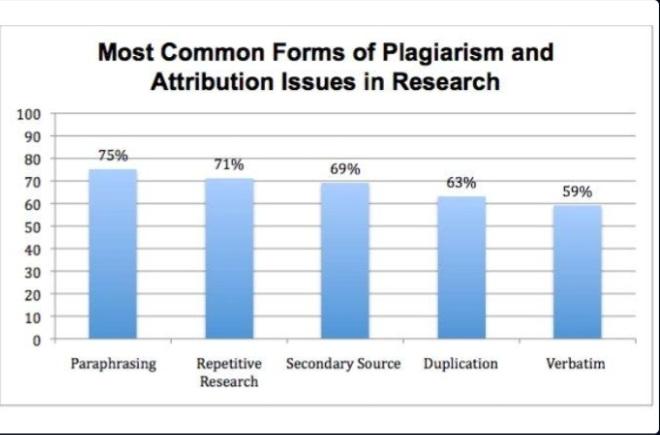


3] Global or Complete Plagiarism


Global or complete plagiarism is a form of intellectual theft that involves copying an entire work, without giving proper attribution to the original author. This type of plagiarism can occur in various forms, including copying a book, article, research paper, or even a website. In essence, it is an act of claiming someone else's intellectual property as one's own without any acknowledgment or consent.


Global plagiarism is a serious offense and is considered a violation of copyright laws, which protect the rights of original creators. When an individual is caught engaging in this type of plagiarism, they can face legal action, fines, or even imprisonment,depending on the severity of the offense and the country's laws. Additionally, global plagiarism can also damage an individual's reputation, as it is a clear indication of dishonesty and lack of academic integrity.


One of the main reasons why global plagiarism occurs is due to a lack of understanding of what constitutes plagiarism and the importance of proper citation. Some individuals may be under the impression that copying a work verbatim is acceptable, especially if they are pressed for time or lack the necessary skills to create an original work. However, this is not the case, as even paraphrasing or summarizing someone else's work without proper attribution can also be considered plagiarism.


To avoid global plagiarism, it is essential to give credit where credit is due. This means citing all sources used in a work and acknowledging the original author's contribution to the field. Additionally, individuals can use plagiarism detection tools to check their work for any instances of unintentional plagiarism. Overall, global plagiarism is a serious offense that can have severe consequences and should be avoided at all costs.


4] Verbatim or Direct Plagiarism


According to Plagiarism in Research — The Complete Guide [eBook], this type of Plagiarism happens when someone copy a part of someone else's work, word-to-word, without providing adequate credits or attributions.


Verbatim or direct plagiarism is a form of plagiarism in which an individual copies a part of someone else's work word-for-word without giving proper attribution or citation. In other words, verbatim plagiarism occurs when an individual reproduces an exact sentence or passage from an original source without putting it in quotation marks or acknowledging the original author.


This type of plagiarism can happen intentionally or unintentionally, but in either case, it is a serious offense that can result in legal action and damage to the individual's reputation. Verbatim plagiarism is particularly concerning in research and academic writing, where originality and integrity are essential.


To avoid verbatim plagiarism, it is important to use proper citation and attribution. Whenever an individual uses someone else's words or ideas, they should put them in quotation marks and provide a proper citation, including the author's name, the title of the work, and the page number. Paraphrasing or summarizing someone else's work without proper citation can also be considered verbatim plagiarism if the ideas and structure of the original work are replicated.


One way to avoid verbatim plagiarism is to use plagiarism detection tools, which can identify similarities between an individual's work and other sources. However, it is important to note that these tools are not foolproof and should be used as a complement to proper citation and attribution.


5] Source-based Plagiarism


As per Plagiarism in Research — The Complete Guide [eBook], this type of plagiarism happens when someone tries to mislead or disguise the natural source of their work.


Source-based plagiarism occurs when someone directly copies words, phrases, sentences, or ideas from a source without giving proper attribution or citation. In other words, it is a type of plagiarism where the author uses someone else's work without acknowledging it.


There are various forms of source-based plagiarism, such as verbatim copying, paraphrasing without attribution, and improper citation. Verbatim copying is the most obvious form of plagiarism, where someone copies the exact words from a source and presents them as their own. Paraphrasing without attribution is a more subtle form of plagiarism, where the author rephrases the original text in their own words but fails to give credit to the original author.


Improper citation is another form of source-based plagiarism, where the author cites a source but fails to follow the correct citation format or omits important details, such as the page number or publication date. This can make it difficult for readers to verify the accuracy of the information or locate the original source.


Source-based plagiarism is a serious ethical and academic offense that can have severe consequences, including academic penalties, damage to reputation, and legal action. To avoid source-based plagiarism, it is important to always give proper attribution and citation to any sources used in your work. This includes both direct quotes and paraphrased information. When in doubt, it is better to err on the side of caution and provide more information rather than less.


6] Ghostwriting


Ghostwriting is a type of plagiarism that occurs when someone hires another person to write, edit or proofread their work without giving any credit or acknowledgement. In other words, ghostwriting is when someone else writes the work and the original author passes it off as their own.


This kind of plagiarism raises serious questions about the academic capabilities of the author because it suggests that they are not able to write their own work, and therefore, are not deserving of the credit or recognition that comes with it. Ghostwriting is particularly common in academic and professional settings, where authors may not have the time or skills to complete the work on their own.


While there are some legitimate reasons for using a ghostwriter, such as when a public figure wants to write a book but doesn't have the time or writing ability, it is important for the author to acknowledge the ghostwriter's contributions to the work. Otherwise, it is considered plagiarism and can lead to serious consequences such as loss of credibility, legal action, and even job loss.


In conclusion, ghostwriting is a type of plagiarism that occurs when someone hires someone else to write, edit or proofread their work without giving them credit. It raises serious questions about the academic abilities of the author and can have serious consequences if discovered.


7] Self-plagiarism


Self-plagiarism refers to the act of reusing one's own previously published or submitted work without proper citation or attribution. Even though the author may own the copyright to their work, they cannot reuse the same work in its entirety or significant portions of it without proper citation.


Self-plagiarism can occur in various forms, such as submitting a previously published paper as new work, recycling sections of a previous manuscript without proper citation, or using the same data to support multiple publications without acknowledging the earlier work.


The primary concern with self-plagiarism is that it misrepresents the amount of original work the author has done. It can also be seen as an attempt to inflate the author's publication record or to present a more impressive academic profile. It is also considered unethical because it is an attempt to gain credit for work that has already been recognized or rewarded.


Therefore, it is important for authors to be aware of the potential for self-plagiarism and take steps to avoid it, such as proper citation and attribution of their own work.


8] Accidental Plagiarism


Accidental plagiarism refers to the unintentional act of presenting someone else's work or ideas as your own. It often happens when one is not careful while using sources and forgets to include proper citations. This can occur through unwitting paraphrasing, missing in-text or end-of-text citations, or not using quotation blocks.


Accidental plagiarism can result in serious consequences, including loss of reputation, damaged academic integrity, and even legal actions. However, it is usually considered less severe than intentional plagiarism. To avoid accidental plagiarism, it is essential to proofread carefully and make sure that all sources are appropriately cited. One can also use plagiarism detection software to check their work for any possible instances of plagiarism. By taking these steps, one can ensure that they are giving credit to the original sources and avoiding any form of plagiarism.


Conclusion


In conclusion, plagiarism is a serious offense in academic and professional settings. It can take various forms, such as verbatim plagiarism, mosaic plagiarism, self-plagiarism, source-based plagiarism, ghostwriting, and accidental plagiarism. Each form of plagiarism poses a threat to the originality and integrity of one's work and can result in severe consequences, including loss of credibility, legal action, and academic or professional penalties. Therefore, it is essential to understand and avoid all forms of plagiarism by properly citing and acknowledging sources, utilizing effective research and writing strategies, and utilizing plagiarism detection tools when necessary.


Work Cited


Deeptanshu D, and Dogra Shubham. “What Is Plagiarism? - The Complete Guide [Ebook]” SciSpace, SciSpace Resources, 18 Oct. 2022,https://typeset.io/resources/the-only-plagiarism-guide-you-will-need/.


Gibaldi, Joseph. MLA Handbook for Writers of Research Papers. Seventh ed., Modern Language Association of America, 2015. 


Hornby, Albert Sydney. Oxford Advanced Learner's Dictionary of Current English / [by] A.S. Hornby ; Editor Jonathan Crowther. Oxford, England :Oxford University Press, 1995.


“Plagiarism.” Merriam-Webster.com Dictionary, Merriam-Webster, https://www.merriam-webster.com/dictionary/plagiarism.


"Plagiarism." University of Oxford, 2023, https://www.ox.ac.uk/students/academic/guidance/skills/plagiarism.


Scribbr. “What Is Plagiarism? | Definition and Examples.” Scribbr, www.scribbr.com/category/plagiarism.


Assignment : 208 : Study of “Comparative Literature in India: An Overview of its History” by Subha Chakraborty Dasgupta.


Study of “Comparative Literature in India: An Overview of its History” by Subha Chakraborty Dasgupta.


Name - Himanshi Parmar

Semester - 4 (Four)

Roll Number - 8

Email. Id. - himanshiparmar3004@gmail.com

Enrollment number - 4069206420210025

Paper number - 208

Paper name - Comparative Literature & Translation Studies

Subject Code - 22415


What is Comparative Studies?

The studies which reveal similarities or differences between different markets, countries, aspects of companies, etc. They help to illustrate links and dissimilarities between these different elements. According to the Merriam-Webster dictionary, 

"Comparative Literature is the study of the interrelationship of the literature of two or more national cultures, usually of differing languages and especially of the influences of one upon the other."

In another words Comparative Literature is traditionally known as the study of two or more literatures in comparison (English and German, for example) and their multi-dimensional components which may encompass aspects such as the historical, gender, economic, cultural, social, philosophical, religious, and linguistic factors of the distinct cultures being analyzed.

Comparative Literature focuses on the study of literature from different cultures, nations, and genres, and explores relationships between literature and other forms of cultural expression. Comparative Literature poses such questions as, What is the place of literature in society? How does literature as a form change over time, and in relation to other forms of making art? How does literature shape and respond to values, social movements, or political contexts?

Abstract

The essay gives an overview of the trajectory of Comparative Literature in India, focusing primarily on the department at Jadavpur University, where it began, and to some extent the department of Modern Indian Languages and Literary Studies in the University of Delhi, where it later had a new beginning in its engagement with Indian literatures. The department at Jadavpur began with the legacy of Rabindranath Tagore’s speech on World Literature and with a modern poet-translator as its founder.While British legacies in the study of literature were evident in the early years, there were also subtle efforts towards a decolonizing process and an overall attempt to enhance and nurture creativity.

Gradually Indian literature began to receive prominence along with literature from the Southern part of the globe. Paradigms of approaches in comparative literary studies also shifted from influence and analogy studies to cross-cultural literary relations, to the focus on reception and transformation. In the last few years Comparative Literature has taken on new perspectives, engaging with different areas of culture and knowledge, particularly those related to marginalized spaces, along with the focus on recovering new areas of non-hierarchical literary relations.

Entire article was divided into seven parts.

1) The Beginning

2) Indian literature as a comparative literature.

3) Centers of comparative literature studies.

4) Reconfiguration of areas of comparison.

5) Research Directions

6) Interface with translation studies and cultural studies.

7) Non - Hierarchical Connectivity.

1) The Beginning

There were texts focusing on comparative aspects of literature in India, both from the point of view of its relation with literatures from other parts of the world particularly Persian, Arabic and English and from the perspective of inter-Indian literary studies, the multilingual context facilitating a seamless journey from and between literatures written in different languages. The idea of world literature gained ground towards the end of the nineteenth century when in Bengal, for instance, translation activities began to be taken up on a large scale and poets talked of establishing relations with literatures of the world to promote, as the eminent poet translator Satyendranath Dutta in 1904 stated, “relationships of joy” (Dutta 124). The talk by Rabindranath Tagore entitled “Visvasahitya” (meaning “world literature”), given at the National Council of Education in 1907, served as a pretext to the establishment of the department of Comparative Literature at Jadavpur University in 1956, the same year in which the university started functioning.

Tagore used the word “visvasahitya” (world literature), and stated that the word was generally termed “comparative literature”. His idea of “visvasahitya” was complex, marked by a sense of a community of artists as workers building together an edifice, that of world literature. The eminent poet-translator Satyendranath Dutta in 1904 stated, “relationships of joy” (Dutta 124). The talk by Rabindranath Tagore entitled “Visvasahitya” (meaning “world literature”), given at the National Council of Education in 1907, served as a pretext to the establishment of the department of Comparative Literature at Jadavpur University in 1956, the same year in which the university started functioning.

Tagore (639) used the word “visvasahitya” (world literature), and stated that the word was generally termed “comparative literature”. Buddhadeva Bose brought in a very significant modern poet, Sudhindranath Dutta, also well-known for his translation of Mallarmé and his erudition both in the Indian and the Western context, to teach in the department of Comparative Literature. Bose was again a poet, Naresh Guha, who remained as Chairperson of the department for two decades. In an interview given to us in his last years he emphasized the role of the department in fostering an intensely creative environment.

2) Indian Literature as Comparative Literature

Indian literature entered the syllabus in a fairly substantial manner but not from the point of view of asserting national identity.Modern Indian Languages department established in 1962 in Delhi University. In 1974, the department of Modern Indian Languages started a post-MA course entitled “Comparative Indian Literature”. A national seminar on Comparative Literature was held in Delhi University organized by Nagendra, a writer-critic who taught in the Hindi department of Delhi University and a volume entitled Comparative Literature was published in 1977. However, it was only in 1994 that an MA course in Comparative Indian Literature began in the department. As stated earlier the juxtaposition of different canons had led to the questioning of universalist canons right from the beginning of comparative studies in India and now with the focus shifting to Indian literature, and in some instances to literatures from the Southern part of the globe, one moved further away from subscribing to a priori questions related to canon formation.

Older definitions of Indian literature often with only Sanskrit at the centre, with the focus on a few canonical texts to the neglect of others, particularly oral and performative traditions, had to be abandoned. Aijaz Ahmad,says that “the dialectic of unity and difference through systematic periodization of multiple linguistic overlaps, and by grounding that dialectic in the history of material productions, ideological struggles, competing conceptions of class and community and gender, elite offensives and popular resistances, overlaps of cultural vocabularies and performative genres, and histories of orality and writing and print” (Ahmad 265).

Sisir Kumar Das, a faculty member at the department of Modern Indian Languages and Literary Studies, with support from other members of the department and the Sahitya Akademi. The department continues to develop teaching material on various aspects of Indian literature from a comparative perspective, beginning from language origins, manuscript cultures,performative traditions along with painting, sculpture and
architecture, the history of print culture and questions related to modernity. T.S. Satyanath developed the theory of a scripto-centric, body-centric and phono-centric study of texts in the medieval period leading a number of researchers in the department to look for continuities and interventions in the tradition that would again lead to pluralist epistemologies in the study of Indian literature and culture.

3) Centres of Comparative Literature Studies

Comparative Literature was also practiced at a number of centres and departments in the South of India such as in Trivandrum, Madurai Kamaraj University, Bharati dasam University, Kottayam and Pondicherry. The Comparative Literary Studies department was established in the School of Tamil Studies in Madurai Kamaraj University.In Tamil, apart from studies related to the comparison of texts from two different cultures, Classical Tamil texts were compared with texts from the Greek, Latin and Japanese counterpart traditions. Punjabi University, Patiala, Dibrugarh University, Dr Babasaheb Ambedkar Marathwada University, Sambalpur University, Jawaharlal Nehru University and SNDT Women’s University, Mumbai. In 1986 a new full fledged department of Comparative Literature was established at Veer Narmad South Gujarat University, Surat, where focus was on Indian literatures in Western India. Also in 1999 a department of Dravidian Comparative Literature and Philosophy was established in Dravidian University, Kuppam.

The two merged in 1992 and the Comparative Literature Association of India was formed, which today has more than a thousand members. A core area of comparative literature studies and dissertations, particularly in the South, was taken up as a central area of research by the Visvanatha Kaviraja Institute of Comparative Literature and Aesthetics in Orissa.

4)Reconfiguration of areas of comparison

In the last years of the seventies, along with Indian literatures, Gabriel Garcia Marquez’s One Hundred Years of Solitude became a part of the syllabus with a few other texts from Latin American Literatures and then Literatures from African countries were included. During the nineties, Area Studies papers on African, Latin American, Canadian literatures and literature of Bangladesh were introduced.Area studies components in Chinese and Japanese literatures were also framed, but it was not possible to offer the courses in the absence of specialized faculty members.Components from the diverse Area Studies could possibly have been included as integrated parts of the main curriculum.Right from the beginning of the discipline in India, cross-cultural relations between Indian literatures and European and American literatures had been in focus.

The term “influence” began to be questioned by several scholars and particularly so in colonised countries where there was a tendency to look for influences even when they were non-existent.The focus therefore shifted to reception in books like the one by the present author entitled Bibliography of Reception of World Literature in Bengali Periodicals (1890 – 1990). Reception studies also pointed to historical realities determining conditions of acceptability and hence to complex configurations between literature and history. To give an instance, it seemed that romanticism of a particular kind had an easy access into the realm of Bengali literature, but it was a romanticism that did not accept many of the European elements. The translation of several texts from Sanskrit into German played a role in the emergence of the Romantic movement and then in the late nineteenth and early twentieth centuries Romanticism came back to India, though in different shades.

At Jadavpur, under the guidance of Amiya Dev, Master’s syllabus was designed that had genres, themes and literary historiography as its core area and this model was more or less followed in many new departments of comparative literature that would come up later. Two groups of papers were offered, one with components from Indian literature at the centre and the other with Western literature.The division was not a happy one as students wanted to engage with both in order to have nuanced understandings of the interplay between local, national and transnational forces. Rudyard Kipling’s Kim and Rabindranath Tagore’s Gora, were taken up, or sometimes in courses entitled Literary Transactions one looked more precisely at the tradition of Reason and Rationalism in European and Indian literatures of the eighteenth and the nineteenth centuries.

5)Research directions

The late nineties and the early twenties were a period of great expansion for Comparative Literature research in different parts of the country with the University Grants Commission opening its Special Assistance Programme for research in university departments. The English department of Calcutta University for instance, received assistance to pursue research on literary relations between Europe and India in the nineteenth century. Saurashtra University, Rajkot, took up the theme of Indian Renaissance and translated several Indian authors into English, studied early travelogues from Western India to England and in general published collections of theoretical discourse from the nineteenth century. The notion of derived categories for instance, was quite often charged with a host of other significations, as for example, in the case of Romanticism as a term for periodization. Romanticism had very different dimensions in the Indian context and necessitated a different reading within a continuum that situated it often at the source of modernity.

Under the Special Assistance programme the department also conducted eight inter-literary translation workshops translating texts from one Indian language to another without the mediation of English, a process not very common in the field of translation at the time. Among the projects planned under the inter-Asian series was one on travelogues from Bengal to Asian countries and here an annotated bibliography that could provide an initial foundation for the study of inter literary relations was published. A second project involved working on the image of Burma in Bengali and Oriya literature in the late nineteenth and early twentieth century. Under a different grant, the tradition of Bhakti and Sufi were studied together and a volume was published.

6)Interface with Translation Studies and Cultural Studies

Comparative Literature in the country in the 21st century engaged with two other related fields of study, one was Translation Studies and the other Cultural Studies.Comparative Literature’s relationship with Translation Studies was not a new phenomenon for one or two departments or centres, such as the one in Hyderabad University.Comparative Literature today have courses on Translation or Translation Studies.The department of Comparative Literature at Jadavpur University today has a Centre for the Translation of Indian Literatures.Comparative Literature also offer modules on Comparative Cultural Studies where key texts in the global field are juxtaposed with related texts from the Indian context. MPhil course on the subject at Jadavpur University highlights changing marginalities, ‘subcultures’ and movements in relation to contemporary nationalisms and globalization, and also sexualities, gender and the politics of identity. Cultural Studies may also be a key component in different kinds of interdisciplinary courses within the discipline.

Delhi University takes up the theme of city and village in Indian literature and goes into representations of human habitat systems and ecology in literature, looks for concepts and terms for such settlements, goes into archaeological evidences and the accounts of travellers from Greece, China, Persia and Portugal to demonstrate the differences that exist at levels of perception and ideological positions.

7)Non-hierarchical connectivity

Comparative Literature in the country today has multifaceted goals and visions in accordance with historical needs, both local and planetary. As in the case of humanities and literary studies, the discipline too is engaged with issues that would lead to the enhancement of civilizational gestures, against forces that are divisive and that constantly reduce the potentials of human beings. Kumkum Sangari in a recent article called “co-construction”,a process anchored in “subtle and complex histories of translation, circulation and extraction” (Sangari 50). comparators work with the knowledge that a lot remains to be done and that the task of the construction of literary histories, in terms of literary relations among neighbouring regions, and of larger wholes, one of the primary tasks of Comparative Literature today has perhaps yet to begin.


Work Cited

“Comparative.” Merriam-Webster.com Dictionary, Merriam Webster,https://www.merriamwebster.com/dictionary/comparative.

Subha Dasgupta, Chakraborty. “Comparative Literature in India: An Overview of Its History.” cwliterature.org, Google , May 2016,http://cwliterature.org/uploadfile/2016/0711/20160711020042997.pdf. 


Tuesday, 28 March 2023

Assignment : 207 : Thematic Study of the novel 'Gun Island' by Amitav Ghosh


Thematic study of the novel 'Gun Island' by Amitav Ghosh


Name - Himanshi Parmar

Semester - 4 (Four)

Roll Number - 8

Email. Id. - himanshiparmar3004@gmail.com

Enrollment number - 4069206420210025

Paper number - 207

Paper name - Contemporary Literatures in English

Subject Code - 22414


What is the theme?

According to the Oxford Dictionary, Theme is the subject of a talk, a piece of writing or a work of art.

Another definition given by Merriam Webster dictionary, Theme is a subject or topic of discourse or of artistic representation. Or a specific and distinctive quality, characteristic, or concern.

Theme refers to the central idea or underlying message that runs throughout a work of art, literature, film, or any other form of creative expression. It is the fundamental concept or motif that the author or creator is trying to convey through their work.

In literature, for example, the theme is the universal idea or concept that the author wants to communicate to the reader through their story. It is often expressed indirectly through the characters, setting, plot, and other literary elements. Some common themes in literature include love, betrayal, redemption, loss, and the human condition.

The theme of a work is not the same as the plot or storyline. While the plot is the sequence of events that make up the narrative, the theme is the underlying meaning or message behind those events. Themes can be implicit or explicit, meaning they may be stated outright or inferred through the work. Some themes may be universal, while others may be specific to a particular culture or time period. They can also evolve and change over time as societal norms and values shift.

About 'Gun Island'

Gun Island is a novel by Amitav Ghosh that was published in 2019. The novel is set across various locations around the world, including Kolkata, Venice, Los Angeles, and the Sundarbans delta in Bangladesh. The novel is a combination of historical and contemporary fiction that explores the themes of migration, climate change, mythology, and human connection.

The protagonist of the novel is Deen, a rare book dealer from Kolkata, who travels to the Sundarbans delta to investigate the story of the Gun Merchant, a mythological figure who is said to have traded guns for slaves. Deen meets Piya, an American marine biologist of Bangladeshi descent, who is researching the effects of climate change on the delta's ecosystem. Together they embark on a journey to uncover the truth behind the myth of the Gun Merchant.

The novel explores the impact of climate change on the Sundarbans delta, which is sinking due to rising sea levels. The characters witness the devastating effects of cyclones and flooding on the region and the people who live there. Through Deen and Piya's journey, the novel also delves into the history of the delta and the impact of colonialism and slavery on the region.

As the story progresses, Deen becomes obsessed with the idea that the myth of the Gun Merchant might be true. He travels to Venice, where he meets Cinta, a woman who claims to be able to communicate with spirits. Cinta tells Deen a story about a group of refugees who fled Bangladesh during the 1971 war and settled in Los Angeles. Deen believes that this story might hold the key to the truth about the Gun Merchant.

Gun Island is a novel that explores the complex connections between people, cultures, and the environment. It shows how myths and legends can shape our understanding of the world and our place in it. The novel also highlights the urgent need to address the issue of climate change and its impact on vulnerable communities around the world. Overall, Gun Island is a powerful and thought-provoking novel that offers a rich and multifaceted exploration of some of the most pressing issues of our time.

Themes in Gun IsIsland

1] Climate Change

Gun Island is a novel written by Amitav Ghosh as an answer to the questions raised in his previous book, The Great Derangement: Climate Change and the Unthinkable. The Great Derangement is divided into three sections: stories, history, and politics. In the first section, Ghosh discusses how climate change seems unreal and uses examples from Gun Island to show how the novel includes unreal and uncanny elements like the character Cinta talking to her deceased daughter. He also introduces the story of Manasa Devi and the spirit of the gun merchant as examples of the fantastical elements in the novel.

The second section of The Great Derangement discusses the role of colonialism in the climate crisis. Ghosh argues that the colonial idea of development is partly responsible for the damage done to the environment. In Gun Island, the effects of climate change on the Sundarbans delta are shown through the eyes of Deen, who witnesses the changes happening in his homeland. Ghosh uses Deen's character to illustrate how colonialism and capitalism have had a lasting impact on the environment.

The third section of The Great Derangement focuses on politics and Ghosh's belief that capitalism is responsible for the damage being done to the climate. This is echoed in the themes of Gun Island, where Ghosh uses the character of Cinta to illustrate the negative impact of capitalism on the environment. The examples of the films Sherni and Don't Look Up also show how politics and corporate interests can prevent effective action on climate change. Overall, Gun Island can be seen as a response to the issues raised in The Great Derangement, providing a powerful commentary on the impact of climate change and the urgent need for action. Here are some corpuses that indicate the situation of climate change in the novel.

1. Flood                                                   
2. Storm 
3. Cyclone Aila and Bhola 
4. Calamities 
5. Drought 
6. Reforestation 
7. Famine 
8. Plague 
9. Smoke 
10. Tornado 
11. Greenhouse 
12. Calamities
13. Weather alert
14. Wildfires
15. Tsunami
16. Apocalypse
17. Volcano/Volcanics
18. Temperatures
19. Seismic
20. Earthquake
21. Air quality
22. Global warming
23. Hail storm
24. Coal
25. Tufaan
26. Winds


2] Etymological Mystery 

Amitav Ghosh often employs the technique of etymology in his writing to sustain mystery and suspense by giving uncommon or obscure meanings to common words, creating a sense of ambiguity and uncertainty.

The title of the novel is 'Gun Island'. But the novel has nothing to do with Guns or Bonduk. Also the story is not about any particular Island. Here Gun Island has a different meaning. In the novel the word 'Gun' stands for 'Venice'. Here are some original lines that stands for the statement.

'And through Arabic the name of Venice has travelled far afield, to Persia and parts of India, where to this day guns are known as Bundook - Which is, Of course, none other than 'Venice' or 'Venetian'.

Similarly the word 'Gun Merchant' of course has a different meaning. 'Gun Merchant' or 'Bonduki Sadagar' in the novel means 'A merchant who visited Venice'.

Was it possible that I had completely misunderstood the name ‘Bonduki Sadagar’? Could it be that its meaning was not ‘The Gun Merchant’, as I had thought, but rather, ‘The Merchant who went to Venice’?

There are many other works that have different meanings in the novel, different than its actual meaning. People often think that the word 'Ghetto' is related to Jews somehow. But in the novel 'Gun Island' the word Ghetto has nothing to do with Jews but the word in Venetian dialect for foundry. That is stated in 'Island within an Island'. So the word 'Ghetto' here stands for 'Island within an Island'.

'The old ghetto is an island within an island, as you can see.’

The island that was allotted to the Jews, she said, had previously been a foundry where armaments, including bullets, were cast. The word for foundry in the old Venetian dialect was getto and this had become the name of the city’s Jewish settlement. Not only would this settlement become a great centre of Jewish learning, it would also lead to the coining of certain words, of which ghetto was only one.

The word 'Bhoot' actually means 'Ghost'. But in 'Gun Island' Amitav Ghosh uses the word in a different meaning. In the novel 'Bhoot' means 'Past state of being'. It also stands for memory.

All I can tell you is that the Bangla word “bhoot” or “bhuta” comes from a basic but very complicated Sanskrit root, “bhu”, meaning “to be”, or “to manifest”. So in that sense “bhuta” simply means “a being” or “an existing presence”.'

‘Because “bhuta” also refers to the past, in the sense of “a past state of being”. Like when we say “bhuta-kala” or “times past”.’

The word possession also comes with different meanings in novels. There is a line in the novel that indicates the meaning of possession, ‘Possession is when someone is taken over by a demon.’ but in actual possession is just a metaphor for greed. Here is the line from the original text of Gun Island.

‘It’s nothing. Just a metaphor for greed. An imaginary thing.’

In a chapter titled as 'Warning' cinta said that the word 'Possession' is not demonic or negative. But the real meaning of the word is 'Awakening'. The person who claims that he/she is possessed is awakening to a new life, new personality, new understanding and vision.

Some names of places are also symbolically used by Amitav Ghosh. Such as
1) The Land of palm sugar candy stands for Egypt,
2) Land of Kerchieves (Rumali Desh) is Turkey,
3) The Island of chains (Shilok dwip) is Sicily.

3] Historification of Myth, Mythification of History

In "Gun Island," Amitav Ghosh uses myth and history to add depth and context to the themes of the novel, including climate change and migration. By incorporating elements of Bengali folklore and historical events, Ghosh creates a complex narrative that connects the past and present and highlights the interconnectedness of various cultural, social, and environmental issues. The use of myth, in particular, serves to emphasize the cultural roots of these issues and the ways in which they have been present and relevant throughout history. By blending myth, history, and contemporary events, Ghosh creates a vivid and impactful portrayal of the challenges facing the world today and the need for collective action to address them.

There are so many myths and names of places mentioned in the novel that also exist in the real world. Like, Sundarban, Venice, Gito, Sicily etc. Three symbols mentioned in the novel also have a significant role in the novel. The symbols shown in the shrine of Manasa Devi. All these three symbols are related to the myth of Ilyas. It looks like this.

The very first symbol looks like a hooked Snake and Gun, but it is the first alphabet in Hebrew language and the span stands for Ilias’s identity in the novel.
The second picture seems like it is of Island within an Island, but it's historical location is ghetto.which has foundry and also residences of Jews.
The third image looks like a spider, but in actuality it must be arms. The image might be foundry also.

As per Ghosh the Myth is history, not an imaginary thing.And the novel might be talking about the 17th century because it has references of plague, fire and ‘Bonduki Sadagar’.that all happened during the 17th century. This is how Ghosh mythicized history in the novel.

The present world is facing the problem of human trafficking which was well captured by Amitav Ghosh in the novel.Gun Merchant trapped by pirates and sold in slave markets that indicate human trafficking in present time. Along with that Journey of Tipu and Rafi and the journey of Bilal and Kabir comes as an example of slave trades in present time but in different ways.

In conclusion, We can say that myth is not myth but a history that we are living in 21st century.Concern of myth in novel is historical truth, not universal truth.

4] Migration / Human Trafficking and Refugee Crisis

The theme of migration is a prominent one in Amitav Ghosh's Gun Island. There are three major reasons for people's migration, including

1]War and natural disasters
2]Religious migration
3]Climate refugees

In the novel, two sinking sites are focused on, Sundarban and Venice, which frequently cause migration.here are some of the reasons for migration.

1]Natural Calamities - Lubna Khala

The first reason for migration, natural calamities, is seen through Lubna Khala's experiences. Cyclones and shifting land are common in Sundarban, causing them to move frequently. Additionally, there is a tragic incident where Lubna's brother and niece die due to a snakebite, highlighting the dangers of living in such areas. Lubna expresses her despair, saying,

‘Shob gasé!’ she said. 'Everything’s gone now; the house, the people – the water’s taken it all.'

2] Communal Violence - Bilal and Kabir

The second reason for migration, communal violence, is seen through Bilal and Kabir's experiences. Family issues of Bilal escalate into riots, causing them to be constantly on the run. Bilal explains,

'My uncle and cousins attacked my father and me, so Kabir came to our defence and knocked my uncle down. After that, it was like a riot. Kabir and I managed to get away.but from then on, we had to be constantly on the run.’

3] Poverty - Tipu and Rafi

The third reason for migration, poverty, is highlighted through the stories of Tipu and Rafi. Life in Sundarban is challenging, and they had to leave due to the lack of opportunities. Rafi shares his story, saying,

 "We had some clothes, a bit of food, and around 250 US dollars each, that’s all. The dalal put us on a minibus, along with a group of other men. I was carrying only a backpack, and so was Tipu. We had some clothes, a bit of food, and around 250 US dollars each, that’s all."

4]Socio - Economic conditions - Palash

Socio-economic conditions can also be a cause of migration, as seen through Palash's story. Palash migrated to Italy as a student, which set him apart from most Bengali migrants. He came from a wealthy family with a good education and opportunities. Palash reflects on his background, stating,

‘I came to Italy as a student, you see, which sets me apart from most
Bengali migrants. Back in Bangladesh, my circumstances were completely different from theirs. Most of them are from villages and small towns, while my father is a banker, in Dhaka. My older brother is a civil servant, quite high up. I studied at Dhaka University and even have a degree in management. For some years I worked as a manager in a multinational corporation. I used to go to work in a car every day, wearing a suit and tie.’

At last, Gun Island highlights the various reasons for migration through the experiences of its characters. The sinking sites of Sundarban and Venice lead to frequent movement due to natural calamities and climate change. Additionally, communal violence, poverty, and socio-economic conditions can also be reasons for migration. Ghosh provides a vivid portrayal of the challenges faced by migrants, whether it be the danger of living in a sinking site or the difficulty of finding a new home.

Conclusion

In conclusion, Amitav Ghosh's Gun Island is a richly thematic novel that explores a range of issues such as climate change, migration, historification of myth, mythification of history, and etymological mystery. Through the story of Dinanath and his encounter with a range of characters, the novel shows how climate change is affecting people's lives and causing them to migrate from their homes.

 It also highlights how colonialism has contributed to climate change and how capitalism is responsible for the damage we are doing to the environment. Furthermore, the novel explores the complex relationships between history and myth, showing how these two forms of storytelling can influence each other in unexpected ways. Overall, Gun Island is a thought-provoking and beautifully written novel that engages with some of the most pressing issues of our time.


Work Cited -

Amitav Ghosh: Gun Island. Chicago Humanities Festival, 2020,https://www.youtube.com/watch?v=MPsj_lstkBs.

Amitav Ghosh on "Gun Island" | 2019 National Book Festival. PBS Books, 2020, https://www.youtube.com/watch?v=A1ThLi0wkMw.

Barad, Dilip. “Gun Island (Sem 4-2022).” YouTube, 19 February 2022,https://www.youtube.com/playlist?list=PLSmZQVxjN9_iDDfODO-NC3Le2cOAd9Xnt.

Clark, Alex. “Gun Island by Amitav Ghosh review – climate and culture in crisis.” The Guardian, 5 June 2019, https://www.theguardian.com/books/2019/jun/05/gun-island-amitav-ghosh-review.

Francis, Ashna. “Gun Island: A Tale of Myth, Migration and Climate Change.” vol. 9, no. 9, September 2021.

Ghosh, Amitav. Amitav Ghosh : Home,https://www.amitavghosh.com/.

Ghosh, Amitav. Gun Island. Penguin Random House India, 2019.


Foundations of Digital Communication (Concept, Nature, Evolution and Types of Digital Communication)

  Unit - 1 Concept, Nature and Evolution of Digital Communication Introduction Communication is the process of sharing information, ideas, f...